← Blog GEO Strategy ChatGPT SMEs
Get noticed in ChatGPT: here’s how to be included in the answer
2026-08-03 · Martin Nymann · 8 min reading
Five steps in the order supported by our own measurements — with an honest answer as to what you can do yourself, and what the technology cannot do for you.
Key takeaways
- The order trumps the list: let the AI crawlers in, put the core content in the raw HTML, tidy up the directories, and answer the right questions.
- You can complete two of the five steps yourself in an afternoon. The step that requires a developer — server-side rendering — is also the most important one.
- In 465 Danish companies, 41 per cent were mentioned by at least one of the four drivers. Just over half were not mentioned by any of them.
- Technique is the ticket to entry, not victory: it is a strong predictor of whether you are CITED as a source (p=0.000) and has no bearing on whether you are RECOMMENDED (p=0.988).
- We are deliberately not putting a figure on how quickly it works — we haven’t yet tracked the same companies over time.
See whether ChatGPT mentions your business — free test
Become visible in ChatGPT: Allow AI crawlers in robots.txt, include your most important answers as readable text in the raw HTML, add structured data, and ensure your business is listed correctly in the directories that the search engines actually reference. This guide walks you through the process — and also explains what this technique cannot do for you.
The order is more important than the list. Most people start with the content before the page can even be read by an AI crawler, and so are never indexed. Below are the steps in the order supported by our own measurements, with an honest estimate of what each step will cost you.
Why is it difficult to get into ChatGPT?
Because there’s only room for a few. When a customer asks “who’s the best accountant in Aalborg?”, the search engine typically lists a handful of firms — the rest simply don’t exist for that customer. In our own survey of 465 Danish companies, 41 per cent were mentioned by at least one search engine. Just over half were therefore not mentioned by any, and most of them had a perfectly ordinary, technically sound website.
Research suggests that the text can actually make a difference. Aggarwal et al. (KDD 2024) measured, using a benchmark of 10,000 searches, that targeted content changes can boost visibility in generative search engines by up to 40% — with the caveat that the effect varies considerably across domains, and that the study was conducted in English.
And some of what counts lies outside your website. Ahrefs compared 75,000 brands with their visibility in Google AI Overviews (26 May 2025) and found that mentions of the brand were more closely correlated with visibility (0.664) than backlinks were (0.218). This is a correlation, not proof of causation — but it aligns with what we measured ourselves: the only six domains the search engines cited across all three industries were directories and registries.
What’s required — and in what order?
Five steps, ordered so that the cheapest and most crucial are at the top. The ‘Can you do it yourself?’ column is the honest answer to whether you need a developer.
| Step | What it is | Can you do it yourself? |
|---|---|---|
| 1. Allow the crawlers in | Check that robots.txt isn’t blocking GPTBot, ClaudeBot, PerplexityBot and Google-Extended | Yes — 10 minutes |
| 2. Insert the content into the HTML | Services, geography and contact details must be included in the code, not fetched via JavaScript | No — requires a developer |
| 3. Tidy up the directories | Krak, De Gule Sider, findformig, Trustpilot, LinkedIn — the same name, address and telephone number everywhere | Yes — one afternoon |
| 4. Answer the right questions | One page per question, answer in the first paragraph, specific figures | Yes — ongoing |
| 5. Structured data | JSON-LD that tells who you are, where you are, and what you offer | Partially — often a plugin |
Note that steps 1 and 3 are the ones you can do today without help — and that step 2 is what most often renders a site completely invisible. Of 465 Danish business websites scanned, 22 had virtually no readable text without JavaScript. This is the most expensive to fix and the most important to get right; the background is that 1 in 20 Danish business websites are effectively invisible to ChatGPT.
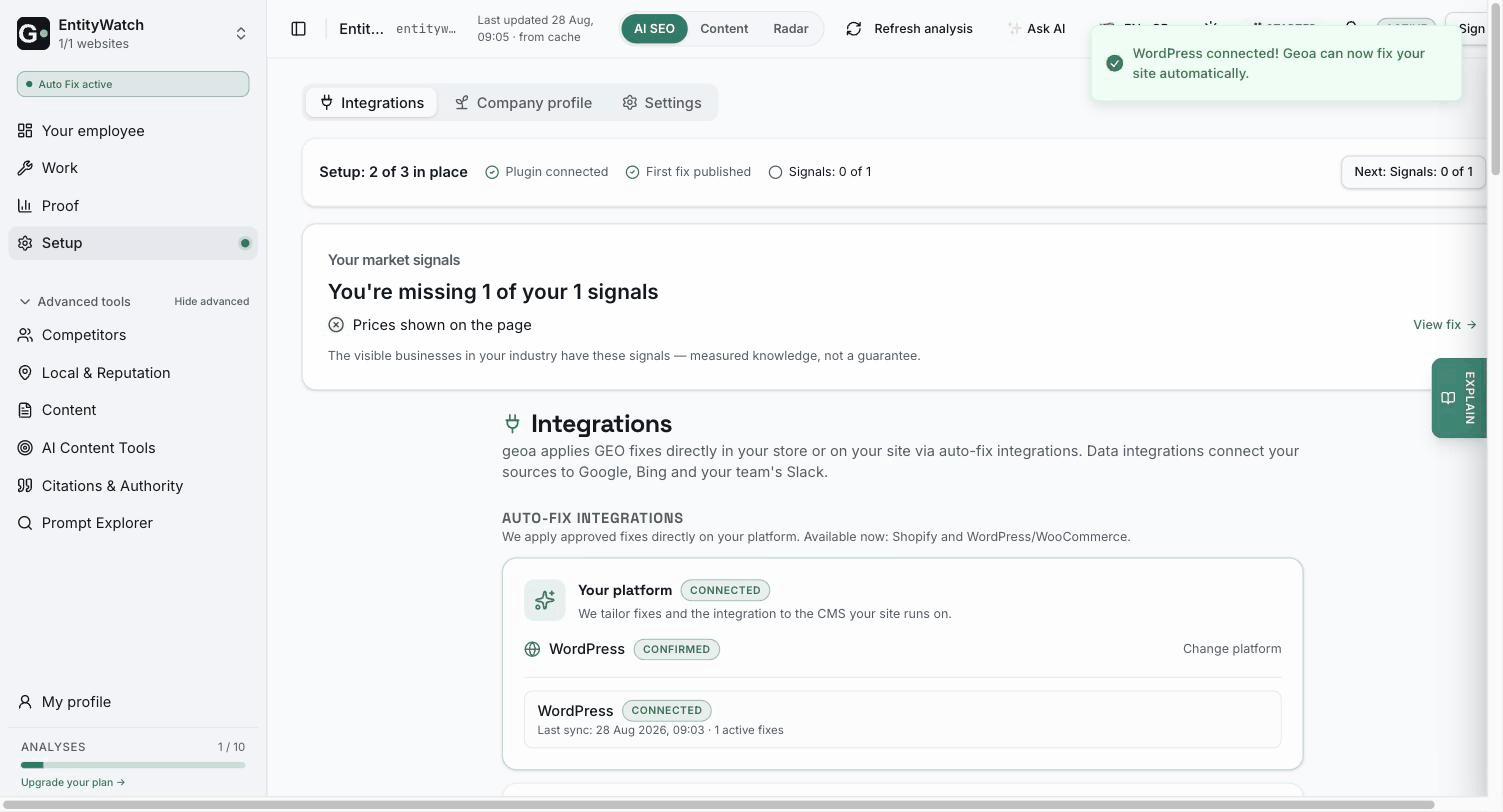
What did we do on our own site?
We tested it on a product we own ourselves before recommending it to others. Relark.dk was built by the same founder as Geoa — so this isn’t a client case study, but our own ‘dogfooding’, and the entire process is openly documented on the case study page.
The starting point was a GEO Score of 49.9 out of 100. Relark is a React app where the content is built in the browser, so the AI crawlers essentially saw a blank page — exactly error number 2 in the table above. The five technical dimensions that improved the most were AI crawler access, structured data, internal links, server-side rendering and E-E-A-T content. The work required by the company itself amounted to around 10 minutes a week.
And that’s as far as we can document. We’ve measured that the technical dimensions went from red to green. We have not measured whether ChatGPT subsequently began to mention Relark more frequently — that would require tracking the same companies over time, and we have not carried out that measurement. To claim otherwise would contradict our own dataset, as you can see in the next section.
What can’t the technology do for you?
It cannot buy you a recommendation. When we asked four AI engines 576 customer questions about 465 Danish companies, the pages cited as sources had a technical score of 77.9 compared with 72.7 for the others — highly significant (p=0.000). However, the companies that the engines recommended by name scored 74.9 compared with 74.9. No difference (p=0.988).
The technical aspect is therefore the ticket to entry, not the victory. It determines whether your page can be used as a source. Who the search engine highlights is determined by other factors — coverage, reputation and demand — and these take longer to build. The full analysis can be found in ‘What determines whether AI mentions your company’.
How quickly does it work?
We don’t know exactly, and we won’t speculate. What we can say is what is technically true: AI crawlers fetch pages on an ongoing basis, so a corrected robots.txt or a new server-rendered page may be fetched within days to weeks. We haven’t measured whether or when this changes what a search engine returns.
We have deliberately not put a figure on it, because this is the sort of promise the industry is full of, and which no one can substantiate. Once we have tracked the same companies over time, we’ll publish the results — even if they show nothing.
Frequently asked questions
How does my business get into ChatGPT?
By doing four things in order: let the AI crawlers into robots.txt, ensure that the core content is in the raw HTML without JavaScript, tidy up the directories that the search engines actually index, and answer the questions customers ask — one question per page, with the answer first. You can do steps 1 and 3 yourself today; step 2 usually requires a developer.
How many companies mention ChatGPT in a response?
Typically, just a handful. In our survey of 465 Danish companies, 41 per cent were mentioned by at least one in four search engines in response to common customer queries — the rest were not mentioned by any. That’s why it’s a question of making it into a small group, not of ranking high on a long list.
Is llms.txt enough to make it into ChatGPT?
No. In our own figures, 6 per cent of the mentioned plumbing firms had an llms.txt, compared with 13 per cent of those not mentioned, and among accountants, 10 per cent compared with 16 per cent. The figures are small and do not prove that the file is harmful — but we cannot confirm that it will make the AI mention you. It is cheap to create and makes the content easier to find; it is simply not decisive.
How quickly does it work?
We haven’t measured this, and we don’t put a figure on it. Technically, it’s true that AI crawlers fetch pages on an ongoing basis, so a correction may be picked up within days to weeks. Whether this changes what the search engine returns, and when, requires tracking the same companies over time — we haven’t carried out that measurement yet.
Can I do this myself, or do I need help?
You can complete two of the five steps yourself in an afternoon: checking robots.txt and tidying up your directory profiles. Structured data is often handled using a plugin. The step that typically requires a developer is to have the content server-rendered so that it appears in the HTML — and that’s also the part that matters most.
See what the AI crawlers are reading on your site
Run the free GEO-test and get the five priority steps for your specific site — 60 seconds, no login required. If you’re unsure about the order, please contact us at contact@addonnordic.dk.
Check my site for free →Sources and disclaimers
The Danish figures are Geoa’s own measurements: 465 search-visible Danish business websites scanned on 21 July 2026, and 576 AI responses collected on 26 July 2026 (12 cities × 4 question variants × 4 search engines). The sample consists of search-visible companies, not a random cross-section of the industry. The methodology and full disclaimers are set out in the full analysis.
External sources: Aggarwal et al., “GEO: Generative Engine Optimisation", KDD 2024 (benchmark based on 10,000 English-language searches; “up to 40%” is a maximum, not an average) · Ahrefs, brand mentions versus backlinks in Google AI Overviews (26 May 2025, 75,000 brands) — covers Google AI Overviews alone, and correlation does not imply causation.
Relark.dk is a product built by the same founder as Geoa. However, it is a ‘dogfooding’ project, not a client case study, and the process is openly documented on the case study page.
Get your free GEO Score — 60 seconds, no credit card required.
Get started for freeRelated articles
Stay up to date with more GEO insights for smaller businesses.
- 1 in 20 Danish corporate websites are effectively invisible to ChatGPT
- We asked four AI engines about 465 Danish companies: the technology determines whether you’re quoted — not whether you’re recommended
- How to improve your GEO Score — 7 practical steps for smaller businesses
- How much does ChatGPT cost for businesses? Prices for 2026 — and the cost most people overlook