← Blog GEO GEO Score Optimisation SMEs E-E-A-T
How to improve your GEO Score — 7 practical steps for smaller businesses
2026-07-07 · Martin Nymann · 9 min reading
Your GEO score reflects your visibility in ChatGPT, Perplexity and Gemini. Get 7 practical steps to improve your score — from the robots.txt and llms.txt to the JSON-LD schema and E-E-A-T signals. Based on figures from our own scan of 465 Danish company websites.
See whether ChatGPT mentions your business — free test
Your GEO Score reflects your visibility in ChatGPT, Perplexity and Gemini. In our scan of 465 Danish company websites on 21 July 2026, the median score ranged from 70 to 85 depending on the sector — and the same gaps kept cropping up. Here are 7 specific steps to close them.
What is the GEO Score — and why should you measure it?
The GEO Score (Generative Engine Optimisation Score) is an overall measure of your company’s visibility in AI-driven search engines such as ChatGPT, Perplexity and Gemini, based on 15 dimensions such as AI crawler access, structured data, content quality, entity signals and E-E-A-T. In 2026, the GEO Score is the primary indicator of whether AI models reference your company or your competitors. At Geoa, we measure your score across all platforms and provide you with a prioritised action plan for each dimension.
Your GEO Score is not the same as your Google ranking. At KDD ’24, the same optimisations had the greatest impact on lower-ranked pages — so a mediocre Google ranking does not mean you are invisible to AI. However, a low GEO Score means exactly that: the AI models cannot find, read or cite your business.
Why is your GEO score so low?
The vast majority of SME websites are built for people — not for AI crawlers. They look great, but they don’t speak the language of AI models. The 15 dimensions of the GEO Score cover everything from technical accessibility (can GPTBot and ClaudeBot crawl your site?) to content quality (do you have factual statements with source references?) to entity consistency (do your data match across Krak, Trustpilot and LinkedIn?).
We’ve measured this ourselves. In our scan of 465 Danish company websites on 21 July 2026, the most common shortcomings were: 89 per cent without llms.txt, 38% without structured data, 21% completely lacking an H1 heading in the raw HTML, and 5% blocking GPTBot. The good news is that all four issues can be resolved in under an hour. Caveat: the sample consists of companies visible in search results, so a representative sample would probably look worse, not better.
7 practical steps to improve your GEO Score
1. Ensure AI crawlers can access your site
It sounds obvious, but it’s the biggest problem. Many SME websites unintentionally block GPTBot, ClaudeBot and PerplexityBot in their robots.txt file. Check your robots.txt: if you have Disallow: / or are missing explicit ‘Allow’ rules for AI crawlers, you’re invisible. Open your robots.txt in a browser (your-company.dk/robots.txt) and check that GPTBot, ClaudeBot and PerplexityBot have access.
Fix: Add ‘Allow’ rules for AI crawlers at the top of your robots.txt. It takes 2 minutes. We can’t promise a doubling of traffic — but this is a prerequisite: if you block the crawler, you can’t be cited, no matter how good your content is. Relark.dk started at GEO Score 49.9 (F) with AI crawlers blocked; see the full case study detailing what was changed.
2. Create an llms.txt file
llms.txt is a simple Markdown file that gives AI models an overview of your most important content. It is placed in the root of your domain (your-company.dk/llms.txt). Please note: there is no documented citation effect from this file — Ahrefs found in May 2026 that 97 per cent of all llms.txt files were never fetched. We’ve included it as step 2 because it’s inexpensive and may prove relevant, not because its effectiveness has been proven.
Solution: Create an llms.txt file with links to your homepage, pricing, case studies and contact page. Use the format from llmstxt.org. It takes 10 minutes and costs 0 DKK. Read our complete guide: llms.txt — the secret weapon of SMEs.
3. Add JSON-LD schema markup
Structured data in JSON-LD format helps AI models understand your business. Without schema, the AI only sees raw HTML — with schema, it understands that you’re an accountant in Kolding with 15 years’ experience and a 4.8-star rating on Trustpilot. We previously reported that KDD ’24 measured a “+30% citation lift” from schema; the study did not, however, do this — it did not test schema at all, and the figure has been removed. In our own scan, 38% of 465 Danish websites were missing structured data.
Minimum requirements: Organisation (with CVR number, address, sameAs links to LinkedIn and Trustpilot), LocalBusiness (with GeoLocation), and Article (for blog posts). If you sell a service: add the Service schema. If you have customer reviews: add the Review schema with `itemReviewed` set to `Product` (not `Service` — Google Search Console rejects `Service`).
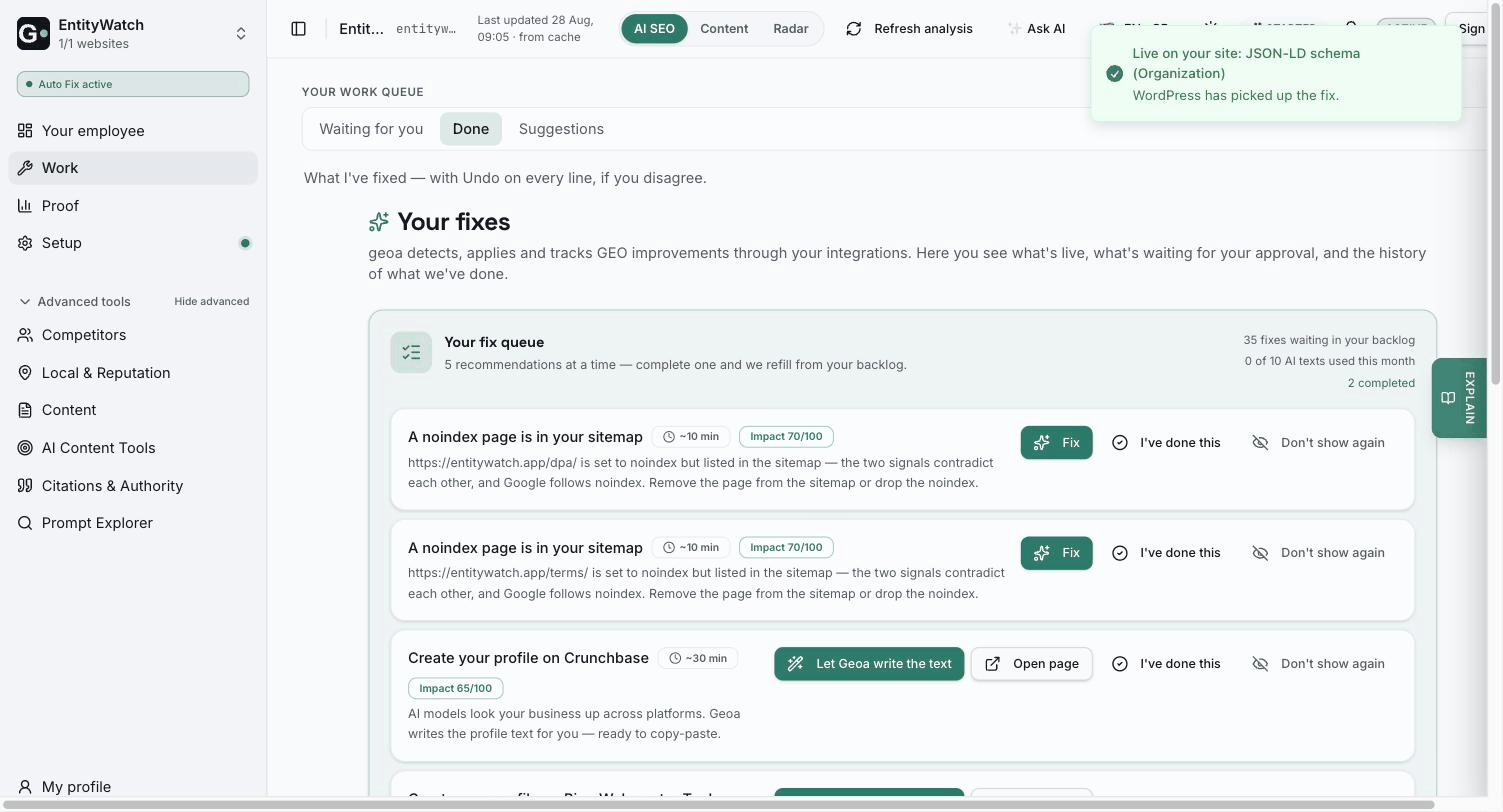
Fix: Use Geoa’s Auto Fix to generate the correct JSON-LD schema in 30 seconds. Or copy the template from the ‘How GEO works’ guide.
4. Optimise your content for AI citation
AI models cite short, factual answers — not long marketing copy. Use the BLUF (Bottom Line Up Front) model: answer the question within the first 60 words of your page. A 2026 study on structure (Yu et al., preprint) found a +17.3% increase in citation rates due to improved structure alone.
Specific tactics: Replace “We offer professional advice” with “We help SMEs in Kolding with VAT and annual accounts — fixed price from 4,900 DKK/year”. Include at least 3 facts per 1,000 words (figures, prices, dates, percentages) — and only figures you can verify yourself. Link to external sources: in KDD ’24, this resulted in a gain of up to +115% for a page ranked 5th, but a loss of −30% for a page that was already ranked 1st.
5. Build your entity signals across platforms
AI models verify your company’s identity across multiple platforms. We are not aware of any reliable measurement of what ‘4+ platforms’ are worth in terms of citations — that figure appeared here previously, attributed to a source that has not published it, and has been removed. The best-documented source in this area is Trustpilot’s own report (May 2026): presence alone accounted for 53.5 per cent, whilst 75.3 per cent required 80+ reviews and regular responses. Treat this as the provider’s own material — it’s still the best publicly available information.
Fix: Check that your CVR number, address, telephone number and opening hours are identical across all platforms. If Krak states something different from your website, the AI will lose trust. Create or update your Trustpilot profile. Link to your LinkedIn page from your website using JSON-LD sameAs.
6. Strengthen your E-E-A-T signals
Experience, Expertise, Authoritativeness, Trustworthiness — E-E-A-T — is the framework that Google (and AI models) use to assess whether your page is worth citing. Claude via Brave Search places enormous weight on E-E-A-T and cites pages with a clear, named author more frequently.
Specific E-E-A-T signals: Write 50 words as the owner about who you are and why you started the business. Include your CVR number (this indicates a Danish, registered business). Have a clear ‘About Us’ section with a photo of yourself. Link to your LinkedIn profile. Display your certifications and memberships. Include a genuine telephone number and a physical address on your website.
The table below shows the maximum impact on the GEO Score. The figures are not estimates: the GEO Score weights 15 dimensions, which together total 100, and a single dimension can therefore never contribute more than its own weight. If you go from 0 to 100 on ‘Structured Data’ (weighting 8), your overall score will increase by 8 points — no more.
| E-E-A-T signal | Effect on the GEO Score | Time to implement |
|---|---|---|
| CVR, founder bio, LinkedIn (E-E-A-T Content Quality) | up to 7 points | 10–15 mins |
| Consistent name, address and data (Brand Entity) | up to 8 points | 1–3 hours |
| JSON-LD schema (Structured Data) | up to 8 points | 15 mins |
| robots.txt open to AI crawlers (AI Crawler Accessibility) | up to 8 points | 2 mins |
| llms.txt file (llms.txt) | up to 6 points | 10 mins |
7. Update your content regularly
AI models appear to prioritise fresh information, but we have not found a metric that is sufficiently well-documented to reproduce — the figure that appeared here previously could not be verified against the source to which it was attributed. Treat freshness as a reasonable assumption, not as a measured effect.
Fix: Add a blog and write at least one post a week. Update your prices and services every month. Add new customer case studies. Even small changes — such as a new date on the front page — signal freshness to AI crawlers. With Geoa, you’ll receive ready-made blog content every week — you can copy and post it in 10 minutes.
If you want the same steps from the customer’s side — what it actually takes before ChatGPT brings your company up at all — how your business gets into ChatGPT walks through the order.
How do you measure your progress?
You can’t improve what you don’t measure. Start with a free GEO-test at Geoa — it takes 60 seconds and gives you your baseline across all 15 dimensions. Then track your progress week by week. The Relark.dk case study shows the process on a real site: starting score 49.9 (F), AI crawlers blocked, and the fixes that were implemented.
The 7 steps above can be carried out in sequence. Steps 1–3 take less than 30 minutes in total and deliver the biggest, quickest improvements. Steps 4–7 require a little more time, but deliver lasting results. Set a calendar reminder to repeat the GEO test every month — that way, you can see exactly which steps work for your business.
— Martin Nymann, Founder, Geoa · CVR 46495985
Sources: Aggarwal, Murahari, Rajpurohit, Kalyan, Narasimhan & Deshpande, “GEO: Generative Engine Optimisation”, KDD ’24 · Yu, Yang, Ding & Sato, “Structural Feature Engineering for GEO”, 2026 (preprint) · Trustpilot, “What AI says about you”, May 2026 · Geoa’s own scan, 465 Danish websites, 21 July 2026
Get your free GEO Score — 60 seconds, no credit card required.
Get started for freeRelated articles
Stay up to date with more GEO insights for smaller businesses.