← Blog AI visibility GEO Score Measurement GEO SMEs
What is an AI visibility score — and how do you check yours for free?
2026-08-03 · Martin Nymann · 7 min reading
An AI visibility score measures whether ChatGPT, Claude, Gemini and Perplexity can find, understand and reference your business — on a scale of 0–100 across 15 dimensions. Here’s what the score covers, what it honestly CAN’T promise you, and how to check yours for free in 60 seconds.
Key takeaways
- An AI visibility score aggregates the signals that determine whether AI engines can find, understand and reference your content — Geoa’s version: 0–100 across 15 dimensions, graded A–F.
- An honest caveat based on our own data (576 AI responses): the technical score is strongly correlated with being CITED as a source — not with being RECOMMENDED. Recommendations also require reputation.
- Google visibility and AI visibility are not the same figure: for 36 per cent of the 176 domains measured, the gap between the two figures was at least 15 points (own survey, August 2026).
- The five most common improvements: opening up access to AI crawlers, content without JavaScript requirements, llms.txt, structured data and a stronger brand entity.
- The test is free, takes 60 seconds and runs on the same engine as the ongoing monitoring — the figure is the actual measurement, not a teaser.
An AI visibility score is a figure that indicates how visible your business is to AI engines such as ChatGPT, Claude, Gemini and Perplexity: can they find your site, understand who you are, and quote you in their responses? Geoa's version scores your domain on a scale of 0–100 across 15 technical dimensions, with grades from A to F — and you can check yours for free in 60 seconds, without logging in or providing a card. Here’s what the score covers, what it can’t promise you, and how to improve it.
What is an AI visibility score?
The concept has emerged because traditional SEO tools measure the wrong thing: they tell you where you rank in Google’s blue links, but say nothing about what’s happening inside the AI answers, where a growing proportion of customers’ research now takes place. The shift is measurable: Ahrefs’ analysis of 300,000 keywords showed a 34.5 per cent lower click-through rate for the top position when an AI answer appears at the top — and 58 per cent in the follow-up measurement in December 2025. An AI visibility score aggregates the signals that determine whether an AI engine can use you as a source when the answer replaces the click.
And these signals can be manipulated: the Princeton/Georgia Tech study (KDD ’24) measured a visibility boost of up to 40 per cent in generative search engines through targeted optimisation of precisely the kinds of signals that a score makes visible.
| Classic SEO score | AI visibility score | |
|---|---|---|
| Measures against | Google’s blue links | AI responses (ChatGPT, Claude, Gemini, Perplexity) |
| Core signals | Rankings, backlinks, keywords | AI crawler access, citability, llms.txt, brand entity |
| Success | Click through to your site | Being found and cited within the answer itself |
| Blind spot | Everything within the AI response | Recommendations also require reputation (see below) |
Geoa's score is based on 15 dimensions, each of which measures a specific signal: are the AI crawlers (GPTBot, ClaudeBot, PerplexityBot) blocked in your robots.txt? Does your content require JavaScript, which AI readers do not run? Do you have structured data, an llms.txt, a unique brand entity, quotable content and E-E-A-T signals? Each dimension is weighted, and the total becomes your score from 0 to 100 — the same engine, whether you’re running the free test or the ongoing monitoring within the platform.
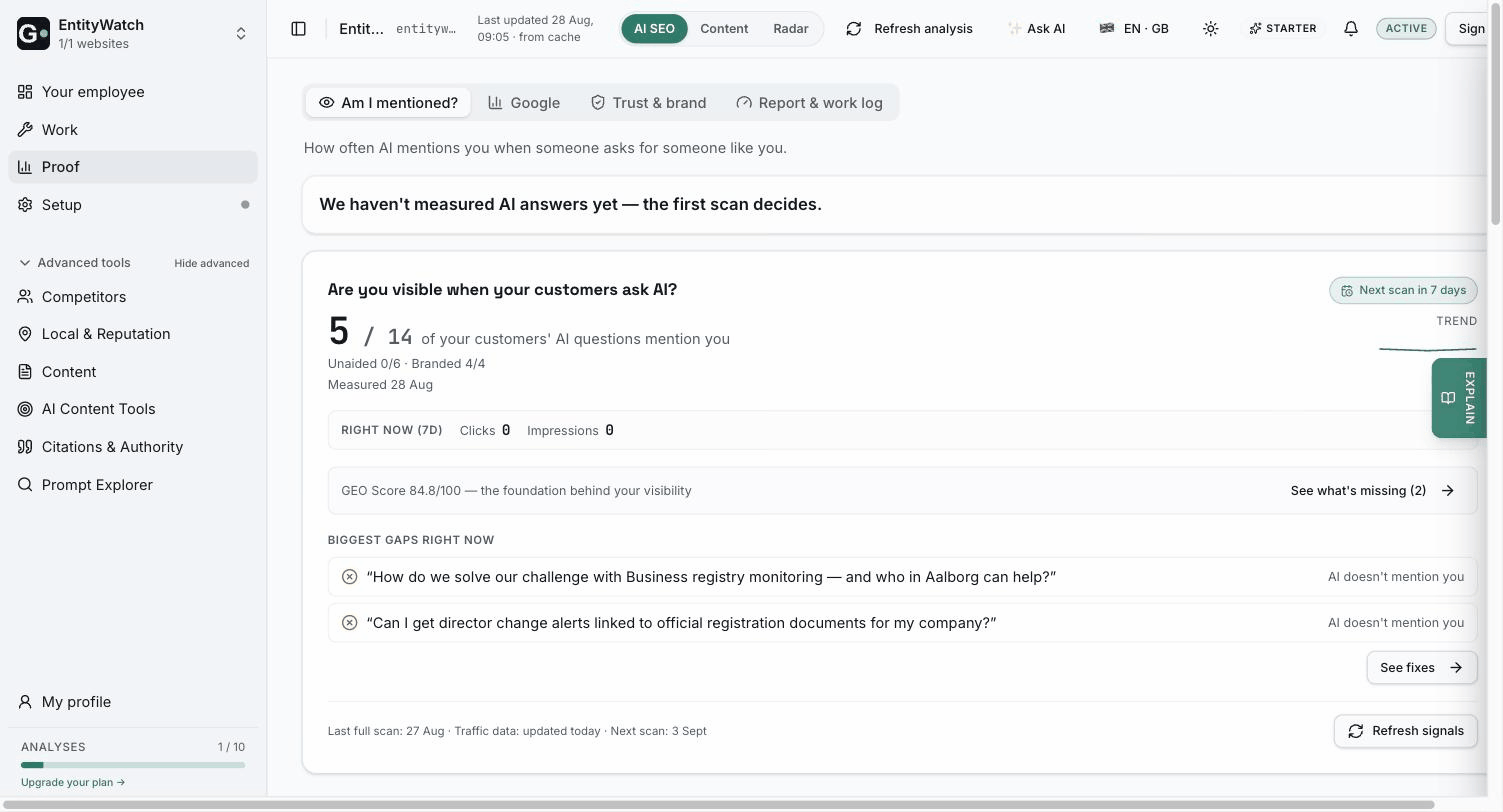
What does the score measure — and what doesn’t it promise?
Here’s the honesty you rarely get from people selling visibility: a technical score can measure whether AI can find and cite you — not whether it will recommend you. We’ve tested this on our own data: in an analysis of 576 AI responses (our own measurement, July 2026), the technical score was a strong predictor of whether a site was cited as a source — and virtually no predictor of whether the company was recommended in the response. Recommendations also depend on your reputation in the wider world: reviews, mentions and third-party validation.
That’s why you should view an AI visibility score as a basic check: a low score means that AI engines are struggling to use you at all — it’s a problem you can fix yourself. A high score means the door is open; whether the AI walks through it depends on your content and your reputation.
Google visibility and AI visibility are not the same figure
When we calibrated our measurement across 176 genuine business domains (our own measurement, August 2026), we found that the difference between traditional Google readiness and AI readiness is significant enough to warrant separate indicators: for 36 per cent of the domains measured, the gap between the two was at least 15 points, and one group was effectively Google-healthy but AI-blind — technically sound sites that AI engines cannot use anyway.
That is why today’s free test displays two indicators: your Google visibility (classic technical search signals: speed, mobile-friendliness, page structure, security) and your AI visibility (AI crawler access, llms.txt, brand entity, citability). One scan, two channels — and it is precisely the gap between them that tells you where your next efforts should be focused. Read more about the two channels in the guide ‘How to make your business visible on Google’ — and on ChatGPT.
How to check your AI visibility score for free
It takes less than a minute, and you don’t need to create an account or enter your card details:
- Enter your domain into the free test — e.g. yourbusiness.co.uk.
- Wait around 60 seconds whilst the scan measures all 15 dimensions of your live site.
- Read the results: the two indicators at the top, your overall score with a grade, all 15 dimensions shown as bars — and the three most important fixes listed first.
The test runs on exactly the same engine as the ongoing monitoring, so the figure isn’t just a teaser — it’s the actual measurement.
How do you improve your score?
The most common findings almost always point to the same five actions, and most can be carried out without outside help:
- Open up access to AI crawlers. GPTBot, ClaudeBot and PerplexityBot need to be able to read your site — many people block them without realising it.
- Ensure that the content can be read without JavaScript. AI readers don’t run it — if your page requires scripts to display text, they’ll see a blank page.
- Publish an llms.txt. In our scan of 465 search-visible Danish business websites (our own survey, July 2026), 89 per cent were missing it — the generator creates it for free.
- Make your facts machine-readable using the Organisation and FAQPage schemas.
- Strengthen your brand entity: consistent profiles, reviews and third-party mentions — this is the part that also drives recommendations.
If you want this done automatically, Geoa continuously monitors both indicators and corrects the technical issues directly on your site — and tracks, week by week, whether you’re being mentioned.
Who needs to measure AI visibility the most?
In short: businesses whose customers do their research before buying. If your customers ask “which accountant should I choose”, ‘best online shop for workwear’ or ‘solicitor for property transactions’, there is a growing likelihood that the question will be put to an AI — and your AI visibility will then determine whether you’re even considered. Purely impulse-driven purchases and brands that people search for by name will see the shift later.
There’s also a timing aspect that’s easy to overlook: because very few Nordic companies are measuring AI visibility yet, the bar is set low. The very work that will become a prerequisite in two years’ time is currently a competitive edge — and a score gives you a figure on which to build that edge, rather than just a hunch.
Frequently asked questions
What is a good AI visibility score?
Above 70 is a solid foundation (grade B or better); below 50 means that AI engines are having specific problems using your data. More important than the number, however, is the direction — and the gap between your two indicators, which shows where your efforts should be focused.
Is an AI visibility score the same as a GEO-score?
Yes, in practice. GEO (Generative Engine Optimisation) is the technical term for the discipline, and the GEO score is our name for the metric — ‘AI visibility score’ is the term used by the market. Read more in the complete GEO guide.
How often should I check my score?
After every major change to your site — and otherwise monthly, if you’re actively working on visibility. The platform’s ongoing monitoring automatically tracks and displays progress week by week, so you don’t have to remember to do it yourself.
Do I need this if I’m already ranking well on Google?
Yes — that’s exactly the situation the two-way measurement is designed for. A site can rank well on Google and still be invisible to AI: in our calibration across 176 domains, 36 per cent had a gap of at least 15 points between the two indicators. Check your own gap for free before jumping to any conclusions.
Get your free GEO Score — 60 seconds, no credit card required.
Get started for free